SyndicatedEducation
Vermont experts say bats need our help. How do we get over our fear of them?
Vermont Fish & Wildlife Department staff and TNC partners conduct an annual hibernaculum bat count for a partner university’s white-nose research in 2024. Photo credit Vermont Fish & Wildlife Dept.

Vermont Fish & Wildlife Department staff and TNC partners conduct an annual hibernaculum bat count for a partner university’s white-nose research in 2024. Photo credit Vermont Fish & Wildlife Dept.
" data-large-file="https://vtdigger.org/wp-content/uploads/2026/10/VFWD-hibernaculum-2024_4-1200x798.jpg" /> Vermont Fish & Wildlife Department staff and TNC partners conduct an annual hibernaculum bat count for a partner university’s white-nose research in 2024. Photo credit Vermont Fish & Wildlife Dept.
" data-large-file="https://vtdigger.org/wp-content/uploads/2026/10/VFWD-hibernaculum-2024_4-1200x798.jpg" src="https://vtdigger.org/wp-content/uploads/2026/10/VFWD-hibernaculum-2024_4-1200x798.jpg" alt="A researcher in a white protective suit, red helmet, and face mask examines a cluster of bats roosting on a cave ceiling." class="wp-image-657090" srcset="https://vtdigger.org/wp-content/uploads/2026/10/VFWD-hibernaculum-2024_4-1200x798.jpg 1200w, https://vtdigger.org/wp-content/uploads/2026/10/VFWD-hibernaculum-2024_4-300x200.jpg 300w, https://vtdigger.org/wp-content/uploads/2026/10/VFWD-hibernaculum-2024_4-125x83.jpg 125w, https://vtdigger.org/wp-content/uploads/2026/10/VFWD-hibernaculum-2024_4-768x511.jpg 768w, https://vtdigger.org/wp-content/uploads/2026/10/VFWD-hibernaculum-2024_4-1536x1022.jpg 1536w, https://vtdigger.org/wp-content/uploads/2026/10/VFWD-hibernaculum-2024_4-2048x1363.jpg 2048w, https://vtdigger.org/wp-content/uploads/2026/10/VFWD-hibernaculum-2024_4-1024x681.jpg 1024w, https://vtdigger.org/wp-content/uploads/2026/10/VFWD-hibernaculum-2024_4-2000x1331.jpg 2000w, https://vtdigger.org/wp-content/uploads/2026/10/VFWD-hibernaculum-2024_4-780x519.jpg 780w, https://vtdigger.org/wp-content/uploads/2026/10/VFWD-hibernaculum-2024_4-400x266.jpg 400w, https://vtdigger.org/wp-content/uploads/2026/10/VFWD-hibernaculum-2024_4-706x470.jpg 706w" sizes="(max-width: 1200px) 100vw, 1200px" />
“There’s some bats in the freezer over there.”
That’s what Alyssa Bennett remembers her boss saying to her when she was starting her job as a small-mammal biologist at the Vermont Fish & Wildlife Department 15 years ago.
Bats are elusive creatures, so whenever officials found a dead one out in the field, Bennett says, they’d often bring it back to the office and store it.
Bennett had some taxidermy experience when she started the job. So she took an eastern red bat from the freezer and made a taxidermied specimen so realistic that one of her co-workers asked how it would be able to breathe in the glass box she’d staged it in, perched on a branch with one wing outstretched.
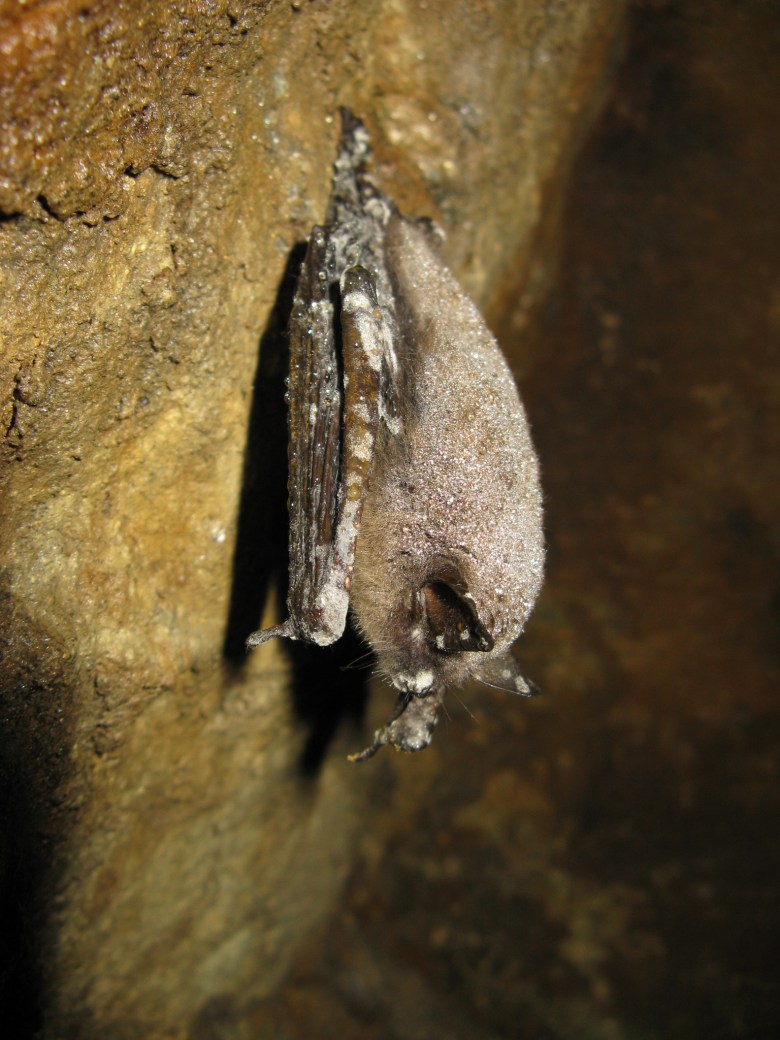
People most often associated bats with the terrifying night monsters of Halloween: blood-sucking, rabid vampires. But, Bennett said, when people started seeing the effects of white-nose syndrome — a contagious fungal infection that has killed nearly 6 million bats in the Northeastern U.S. since 2006 — people’s fear toward bats started to shift.
“People started to see pictures of these struggling, dying bats crawling in the snow in the middle of winter, starved, with shredded wings,” Bennett said. “People who were like, ‘Bats are gross and scary,’ said, ‘I still think they’re gross and scary, but I know they’re in trouble, and I don’t want to hurt them.’”
She said International Bat Week, which takes place during the last week of October, is an opportunity for people to learn more about these species that are rarely encountered otherwise.
Nine species of bats call Vermont home, and five of these are listed by the state or federal government as threatened or endangered. Northern long-eared bats were classified as federally endangered in 2022 in response to the devastation of their population from white-nose syndrome. Various conservation efforts are underway, but experts say there’s a long way to go.
White-nose syndrome
When Barry Genzlinger, a state-licensed bat rehabilitator based in Milton, receives a bat that’s afflicted with white-nose syndrome, it can be a long road to recovery. Even once he’s treated the infection, he said, he still has to keep a close eye on the bat.
“Be on top of that every minute until we see that they are out of the woods, and that takes weeks,” he said.
The fungus that causes white-nose syndrome is not native to North America. It spreads through contact, so bats can catch it from one another or from surfaces like cave walls. It looks like it turns their noses white, but it can spread to the rest of the body, especially during hibernation when their immune systems slow way down.
Alyssa Bennett displays information about white-nose syndrome with some of her taxidermy bats. Credit: Bev Briggs.
" data-large-file="https://vtdigger.org/wp-content/uploads/2026/10/AlyssaDisplayHerricksCove-1200x1600.jpg" src="https://vtdigger.org/wp-content/uploads/2026/10/AlyssaDisplayHerricksCove-1200x1600.jpg" alt="A woman in a green jacket and cap stands next to an educational display board about White-nose Syndrome, featuring text and images of bats." class="wp-image-657092" srcset="https://vtdigger.org/wp-content/uploads/2026/10/AlyssaDisplayHerricksCove-1200x1600.jpg 1200w, https://vtdigger.org/wp-content/uploads/2026/10/AlyssaDisplayHerricksCove-225x300.jpg 225w, https://vtdigger.org/wp-content/uploads/2026/10/AlyssaDisplayHerricksCove-94x125.jpg 94w, https://vtdigger.org/wp-content/uploads/2026/10/AlyssaDisplayHerricksCove-768x1024.jpg 768w, https://vtdigger.org/wp-content/uploads/2026/10/AlyssaDisplayHerricksCove-1152x1536.jpg 1152w, https://vtdigger.org/wp-content/uploads/2026/10/AlyssaDisplayHerricksCove-1536x2048.jpg 1536w, https://vtdigger.org/wp-content/uploads/2026/10/AlyssaDisplayHerricksCove-900x1200.jpg?crop=1 900w, https://vtdigger.org/wp-content/uploads/2026/10/AlyssaDisplayHerricksCove-600x800.jpg?crop=1 600w, https://vtdigger.org/wp-content/uploads/2026/10/AlyssaDisplayHerricksCove-450x600.jpg?crop=1 450w, https://vtdigger.org/wp-content/uploads/2026/10/AlyssaDisplayHerricksCove-300x400.jpg?crop=1 300w, https://vtdigger.org/wp-content/uploads/2026/10/AlyssaDisplayHerricksCove-150x200.jpg?crop=1 150w, https://vtdigger.org/wp-content/uploads/2026/10/AlyssaDisplayHerricksCove-2000x2667.jpg 2000w, https://vtdigger.org/wp-content/uploads/2026/10/AlyssaDisplayHerricksCove-780x1040.jpg 780w, https://vtdigger.org/wp-content/uploads/2026/10/AlyssaDisplayHerricksCove-400x533.jpg 400w, https://vtdigger.org/wp-content/uploads/2026/10/AlyssaDisplayHerricksCove-706x941.jpg 706w, https://vtdigger.org/wp-content/uploads/2026/10/AlyssaDisplayHerricksCove-scaled.jpg 1920w" sizes="(max-width: 1200px) 100vw, 1200px" />
Experts think it makes bats’ skin itchy, so when the creatures are supposed to be resting, they will wake up irritated. Waking up repeatedly through the winter uses up their precious fat stores. When they emerge in the spring and their immune system starts to ramp up to fight the infection, they don’t have enough energy and die.
The fungus also eats away at bats’ wings, causing holes that, in combination with their immune response, can be fatal.
Vermont’s bat populations were hit hard in 2008 and 2009.
Bennett, who started the job in 2011 and saw Fish & Wildlife’s pictures from that time, described “carpets of dead bats” at some sites. When she visited those sites in more recent years, she said, they were like graveyards littered with bat bones.
The syndrome is now endemic, which means it’s established and here to stay. The initial decline of bats has slowed. Bennett said some bats that remain may hold the key to surviving the syndrome, describing the survival of little brown bat populations, in particular, as a potential example of rapid natural selection. She said there’s an evolutionary process happening right before our eyes.
Conservation efforts
Bennett said that before white-nose syndrome, positions like hers didn’t really exist.
“There was a handful of bat biologists working for government agencies before white-nose syndrome came along, and then this introduced fungus that our bats were really naive to just swept through like wildfire,” she said.
Now, she said, most states have someone on staff who does bat work.
Bennett has applied for several grants in recent years that support bat conservation work. She said the availability of these grants is typically announced in the spring, but she is still waiting for those announcements this year.
Three little brown bats with no signs of white nose disease. Photo credit Vermont Fish & Wildlife Dept.
" data-large-file="https://vtdigger.org/wp-content/uploads/2026/10/VFWD-hibernaculum-2024_3-1200x1804.jpg" src="https://vtdigger.org/wp-content/uploads/2026/10/VFWD-hibernaculum-2024_3-1200x1804.jpg" alt="Three small bats hanging upside down from a rocky cave ceiling." class="wp-image-657091" srcset="https://vtdigger.org/wp-content/uploads/2026/10/VFWD-hibernaculum-2024_3-1200x1804.jpg 1200w, https://vtdigger.org/wp-content/uploads/2026/10/VFWD-hibernaculum-2024_3-200x300.jpg 200w, https://vtdigger.org/wp-content/uploads/2026/10/VFWD-hibernaculum-2024_3-83x125.jpg 83w, https://vtdigger.org/wp-content/uploads/2026/10/VFWD-hibernaculum-2024_3-768x1155.jpg 768w, https://vtdigger.org/wp-content/uploads/2026/10/VFWD-hibernaculum-2024_3-1022x1536.jpg 1022w, https://vtdigger.org/wp-content/uploads/2026/10/VFWD-hibernaculum-2024_3-1362x2048.jpg 1362w, https://vtdigger.org/wp-content/uploads/2026/10/VFWD-hibernaculum-2024_3-681x1024.jpg 681w, https://vtdigger.org/wp-content/uploads/2026/10/VFWD-hibernaculum-2024_3-2000x3007.jpg 2000w, https://vtdigger.org/wp-content/uploads/2026/10/VFWD-hibernaculum-2024_3-780x1173.jpg 780w, https://vtdigger.org/wp-content/uploads/2026/10/VFWD-hibernaculum-2024_3-400x601.jpg 400w, https://vtdigger.org/wp-content/uploads/2026/10/VFWD-hibernaculum-2024_3-706x1061.jpg 706w, https://vtdigger.org/wp-content/uploads/2026/10/VFWD-hibernaculum-2024_3-scaled.jpg 1703w" sizes="(max-width: 1200px) 100vw, 1200px" />
Vermont is eligible to apply for certain federal funds that can help Fish & Wildlife acquire tracts of land with critical habitat for two species of endangered bats: the Indiana bat and the northern long-eared bat. Will Duane, the land acquisition coordinator for the department, said it’s exciting to be able to do conservation work in western Vermont that’s focused specifically on bat habitat.
Through that funding source, officially named the Cooperative Endangered Species Conservation Fund, Fish & Wildlife has already received grant money to acquire land in Addison County by the Lemon Fair River in 2024 and on Snake Mountain in 2025. Duane called Snake Mountain an “island of protected biodiversity” surrounded by farmland.
Applications are open for this year’s grants from the conservation fund. Duane said he’s submitting Vermont’s application next month for a project in Dorset in collaboration with The Nature Conservancy and the Trust for Public Land.
Efforts closer to home
This time of year is when bats start looking for a place to hibernate for the winter. That means it’s also a good time for homeowners to take steps to prevent the animals from roosting in their attic. Fish & Wildlife provides guidance for safely removing bats during this season, when they don’t have vulnerable young.
Barry the Bat Guy, as Genzlinger has come to be known, estimates he’s rehabilitated at least 1,000 bats. Many of them arrive to him — or to either of the other two licensed bat rehabilitators in the state — with white-nose syndrome, mites or ticks, or a broken wing. Genzlinger also houses bats that people discover in their homes during the winter. He keeps them safe while they hibernate until the spring, and then releases them.
“It’s the middle of winter,” he said. “You can’t catch a bat and throw them outside. That’s certainly a death sentence. So instead, you call the Bat Center.”
The Vermont Bat Center is a nonprofit organization that provides educational opportunities about bats and supports the state’s three bat rehabilitators.
The center’s website features pictures of the rehabilitation process, including photos of Rusty and Spike, little brown bats who were rescued from a bucket of nails, resisting their checkups and feasting on their first mealworms.
A bat with white nose disease hangs from a cave wall. Photo credit Vermont Fish & Wildlife Dept.
" data-large-file="https://vtdigger.org/wp-content/uploads/2026/10/WNSBatEly-1200x1600.jpg" src="https://vtdigger.org/wp-content/uploads/2026/10/WNSBatEly-1200x1600.jpg" alt="A little brown bat covered in white fungus hanging from a rock wall." class="wp-image-657093" srcset="https://vtdigger.org/wp-content/uploads/2026/10/WNSBatEly-1200x1600.jpg 1200w, https://vtdigger.org/wp-content/uploads/2026/10/WNSBatEly-225x300.jpg 225w, https://vtdigger.org/wp-content/uploads/2026/10/WNSBatEly-94x125.jpg 94w, https://vtdigger.org/wp-content/uploads/2026/10/WNSBatEly-768x1024.jpg 768w, https://vtdigger.org/wp-content/uploads/2026/10/WNSBatEly-1152x1536.jpg 1152w, https://vtdigger.org/wp-content/uploads/2026/10/WNSBatEly-900x1200.jpg?crop=1 900w, https://vtdigger.org/wp-content/uploads/2026/10/WNSBatEly-600x800.jpg?crop=1 600w, https://vtdigger.org/wp-content/uploads/2026/10/WNSBatEly-450x600.jpg?crop=1 450w, https://vtdigger.org/wp-content/uploads/2026/10/WNSBatEly-300x400.jpg?crop=1 300w, https://vtdigger.org/wp-content/uploads/2026/10/WNSBatEly-150x200.jpg?crop=1 150w, https://vtdigger.org/wp-content/uploads/2026/10/WNSBatEly-780x1040.jpg 780w, https://vtdigger.org/wp-content/uploads/2026/10/WNSBatEly-400x533.jpg 400w, https://vtdigger.org/wp-content/uploads/2026/10/WNSBatEly-706x941.jpg 706w, https://vtdigger.org/wp-content/uploads/2026/10/WNSBatEly.jpg 1536w" sizes="(max-width: 1200px) 100vw, 1200px" />
Bats are not easy to encounter up close. The best shot at getting a glimpse is usually after twilight, when they can be seen swooping around to eat mosquitoes and other common insect pests.
Bennett said their mystery might have contributed to humans’ fear factor, which is why it’s important to her — and Genzlinger — to share what they know about bats and demystify them.
They say it’s hard to be scared of a creature that’s about the size of your thumb and weighs less than three pennies.
There’s still a lot to learn about — and from — bats. Researchers from the University of Vermont are studying bats to see if their genetic code holds secrets to cancer treatment and living longer. And the National Wildlife Health Center has been testing a vaccine for white-nose syndrome in the western U.S. Researchers across the country are developing experimental treatments, as well.
Bennett said there’s also a box to check on the Vermont income tax return that would add a contribution to the department’s nongame wildlife fund, which supports the conservation of little brown bats and four other non-bat species in Vermont.
Genzlinger, who would like to see more bat rehabilitators become licensed, particularly in the southern part of the state, emphasized how important it is to protect Vermont’s bat species, especially the endangered and threatened ones.
“If you were to throw one of those out in the snow,” he said, “you might as well be killing a bald eagle or a peregrine falcon.”
Read the story on VTDigger here: Vermont experts say bats need our help. How do we get over our fear of them?.